
Editor’s note: Llinos Evans’s essay traces the literary and linguistic significance of the One-Syllable Article through a detailed reading of Yuen Ren Chao’s “Lion-Eating Poet in the Stone Den”. Moving beyond its reputation as a phonetic curiosity, it argues for the form’s serious poetic, historical, and metalinguistic potential. Situating the discussion within debates on phoneticisation and traditions of constrained composition, the essay shows how extreme formal limits can generate both poetic force and critical insight. In the coming days, five poems will be presented that further explore the possibilities of this form.

[ESSAY] “Beyond the Stone Den: One-Syllable Articles as Literary Form—An Introduction” by Llinos Evans
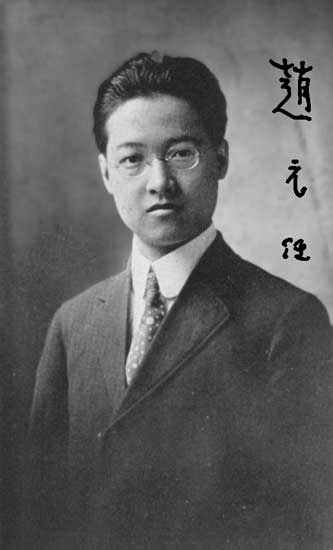
Yuen Ren Chao (Zhào Yuánrèn 趙元任, 1892-1982, pictured right) was one of the most influential figures in the history of Chinese linguistics. The impact of his work, not only on the discipline itself but on the Chinese language more broadly, continues to be felt today. From the standardisation of Mandarin Chinese (Simmons, 2017) to the introduction of Chomskyan linguistics to China (Chao et al., 2002), it is difficult to identify any area of the Sinophone world untouched by his influence. Yet one work, above all, has secured his wider renown: “Lion-Eating Poet in the Stone Den” 施氏食獅史. Let us consider it here (Chao, 1980, pp. 147-151):
施氏食獅史
石室詩士施氏嗜獅。
誓食十獅,施氏時時適市視獅。
十時,適十獅適市。
是時,適施氏適市。
施氏視是十獅,恃矢勢,使十獅逝世。
氏拾是十獅屍,適石室。
石室濕,氏使侍拭石室。
石室拭,氏始試食是十獅屍。
食時,始識是十獅屍,
實十石獅屍!試釋是事…
Literal translation: There was a poet named Shi who lived in a stone house. He was addicted to eating lions. He declared, “I will eat 10 stone lions!” Mr. Shi would often go to the market in search of lions to eat. Today, at 10 o’clock, 10 lions happened to arrive at the market. He watched them and, relying on his bow and arrow, killed them all. He took the carcasses back to his stone house; because it was damp, however, he had his servants wipe them. After that, he began to try to eat the 10 lion corpses. As he was eating, he realised that the 10 lion corpses were in fact the corpses of 10 stone lions. Please try to explain this matter.
At first glance, this text appears to be fairly standard Literary Chinese. When read in Cantonese, however, it reveals itself to be something of a tongue-twister, requiring the reader to move rapidly between a range of fricative sounds:
si1si6 sik6 si1si2
sek6 sat1 si1 si6 si1 si6 si3 si1.
sai6 sik6 sap6 si1, si1 si6 si4 si4 sik1 si5 si6 si1.
sap6 si4, sik1 sap6 si1 sik1 si5.
si6 si4, sik1 si1 si6 sik1 si5.
si1 si6 si6 si6 sap6 si1, ci5 ci2 sai3, si2 sap6 si1 sai6 sai3.
si6 sap6 si6 sap6 si1 si1, sik1 sek6 sat1.
sek6 sat1 sap1, si6 sai2 si6 sik1 sek6 sat1.
sek6 sat1 sik1, si6 ci2 si3 sik6 si6 sap6 si1 si1.
sik6 si4, ci2 sik1 si6 sap6 si1 si1,
sat6 sap6 sek6 si1 si1! si3 sik1 si6 si6…
However, when read in Mandarin…
Shī Shì Shí Shī Shǐ
Shíshì shī shì shī shì, shì shī, shì shí shí shī.
Shī shì shí shí shì shì shī.
Shí shí, shì shí shī shì shì.
Shì shí, shì shī shì shì shì.
Shī shì shì shì shí shī, shì shǐ shì, shǐ shì shí shī shì shì.
Shì shíshì shí shī shī, shì shíshì.
Shíshì shī, shì shǐ shì shì shí shì.
Shí shì shì, shì shǐ shì shí shì shí shī shī.
Shí shí, shǐ shí shì shí shī shī, shí shí shí shī shī.
Shì shì shì shì.
It is all /shi/!
This is what we call a “One-Syllable Article” (Tóngyīn Wénzhāng 同音文章), and it is by far the most famous example of the genre, periodically going viral online, particularly in the West. It is even used in the classroom (Shei et al., 2020), specifically because it differentiates meaning solely through tone. A story that is straightforward and coherent when written becomes, when read aloud in Mandarin, a cacophony of seemingly incomprehensible /shi/. It is impossible to understand without extensive preparation, as even a brief lapse in attention causes meaning to collapse entirely.
Such works are something of an enigma in literature. They exist, yet very few have been composed, and they are often neglected in academic discourse, dismissed as little more than linguistic curiosities. This feature argues that, when approached not merely as a linguistic parlour trick but as a legitimate literary endeavour, One-Syllable Articles can breathe new life into Literary Chinese. The formidable constraint imposed on the writer demands a rigorous engagement with the Han script and with Chinese culture as a whole. Out of this engagement can emerge new narratives, the resurrection of lexical fossils, and, most notably, a testing of the outer limits of what a single syllable can produce.
“Lion-Eating Poem in the Stone Den” can be traced back to a 1916 article by Chao and Suh (1916), in which a slightly different version, attributed to Hu Mingfu 胡明复 (Chao et al., 2002, p. 697), can be found.
石室詩士史氏,嗜豕,失仕,誓食十獅。獅似嗜虱。史氏設寺,恃師勢,使施氏拾獅屍,俟食時,始識世事。史使侍逝適市,視施氏。試釋是事。
Shíshìshīshìshǐshì, shìshǐ, shīshì, shìshíshíshī. Shīsìshìshī. Shǐshìshèsì, shìshīshì, shǐshīshìshíshīshī, shìshíshí, shǐshíshìshì. Shǐshǐshìshìshìshì, shìshīshì. Shìshìshìshì.
The story was quite different as well:
In a stone den lived a poet-scholar named Shi, who craved pork, but lost his post. He swore he’d eat ten lions. Lions seemed to want to meddle with him. Shi set up a shrine, shielded by his master’s influence, and ordered Shi to retrieve the lion’s remains. When the time to eat arrived, he realized the meaning of the world. Shi sent his servant swiftly to the market to seek Shi. Try to explain this matter.
The text was not yet fully homophonous and was clearly a draft. It appears that Chao modified the poem over time, using it for rhetorical purposes. Regardless, this version is extremely difficult to comprehend, even with its slight deviations from perfect homophony. We can observe the influence this text exerted on Chao’s broader approach to Chinese by considering his Gwoyeu Romatzyh romanisation system (Chao, 1970, pp. 13-27, 856), which employs tonal spelling. In this system, 施氏食獅史 becomes Shy Shyh Shyr Shy Shyy. By dispensing with tone diacritics, the system operates entirely within ASCII while simultaneously offering clearer differentiation between homophones such as the /shi/ found throughout this poem.
“Lion-Eating Poet in the Stone Den” is an exercise in linguistic gymnastics. Literary Chinese, as a continuation of the Classical Chinese spoken around 500 B.C., does not account for changes in spoken Chinese across the thousands of years of its use (Yang, 2016). Indeed, it was never intended to do so. Consider the Sino-Xenic pronunciations preserved in Japanese, Okinawan, Korean, and Vietnamese. Phonetic unity was never the aim of the language. Literary Chinese functioned instead as a pan-Asian “scripta franca,” comparable in influence to English, yet lacking a fixed pronunciation and therefore incapable of becoming a spoken language. As a result, one can find accounts from less than a century ago of individuals using Literary Chinese in writing to communicate across foreign lands (D. C. S. Li, 2021; D. C. S. Li et al., 2020). Using Literary Chinese grammar, it is therefore possible to construct a text composed entirely of a single syllable, differentiated only by tone when read aloud in the speaker’s language.
This leads to the definition of a One-Syllable Article: a homophonic text in which every word consists of a single syllable articulated identically, distinguished solely by features such as tone or pitch accent.
Hu Mingfu’s original draft of “Lion-Eating Poet in the Stone Den” was later adopted by Chao to advance a broader argument in favour of written Mandarin Chinese. In this context, Chao advocated for a reduction in stigma and for the use of sounds that are auditorily intelligible (Chao & Suh, 1916). He would later paraphrase the text as follows:
石頭房子裏的詩翁,姓史的,爱吃猪肉,云云
Shítou fángzǐlǐde shīwēng, xìng shǐde, ài chīzhūròu, yúnyún.
The old poet in the stone house, surname Shi, loved to eat pork, and so on.
Thus, illustrating the divide between Literary Chinese and Mandarin Chinese, Chao hypothesised that, because Mandarin uses polysyllabic words and more sonorous syllables, language change towards polysyllabicity could be explained in terms of survival value. Spoken words such as hǎo 好 and yào 要, as Chao observed, do not have other common words sharing the same sound. The broader argument also addressed questions of the phoneticisation of Chinese, and care must be taken not to misinterpret Chao as opposing this development. As a central figure in the creation of Gwoyeu Romatzyh and General Chinese, he was, without any doubt, firmly in favour of phoneticisation. He would later clarify that he regarded only the phoneticisation of Literary Chinese as necessary (Chao, 1980, pp. 150–151), and “Lion-Eating Poet in the Stone Den” serves as an illustration of the limits of his proposal. Only in philology, history, and the study of Literary Chinese did Chao see the Han script as indispensable. Mandarin, Cantonese, Shanghainese, and other topolects, by contrast, were the varieties he wished to see phoneticised.
This was not an implausible claim. Dungan, a Mandarin topolect, and Southern Min have undergone phoneticisation in Cyrillic and Latin scripts respectively, and both remain in common use today (Klöter, 2005; Rimsky-Korsakoff, 1967). Put simply, if one can understand the spoken language, a written representation of it is not inherently absurd. Even prior to Chao’s arguments, the missionary Tarleton Perry Crawford (1821–1902) produced a phonetic script for Shanghainese (Crawford, 1855; Sheng, 1854), which was subsequently used in a number of published works (Cabaniss, 1860; Crawford, 1858; Keith, 1859). Why Chao’s proposal ultimately failed is difficult to determine. It may have been due to the sheer inertia of thousands of years of Han characters, or perhaps to the recognition that phoneticisation was necessary only for certain contexts. It was likely a combination of these factors and others besides. Nonetheless, the imprint of Chao’s thinking remains visible. During the period of Mandarin standardisation, he assisted in the production of a dictionary for Old National Pronunciation, which contained some of the earliest instances of Bopomofo ㄅㄆㄇㄈ (Zhùyīn Fúhào 注音符號), another phoneticisation system (Pronunciation Unification Committee of the Ministry of Education, 1921).
Beyond the rhetorical purpose of this poem, as Chao himself described it, there is a narrative to be drawn from the text and, given the request made at its conclusion, a metaphorical interpretation to consider. Setting aside the linguistic novelty, the work may be appreciated within its historical context and with metalinguistic awareness. The figure of Mr. Shi emerges as a poet scholar living in a stone den, hunting lions and attended by servants. One possible reading treats the lions as words and the servants as his spectacles. Under this interpretation, the narrative becomes coherent. In venturing out to compose a poem, Mr. Shi encounters numerous words that appear distinct and captures them one by one. As he consumes and understands them, he ultimately realises that they are all the same, and the potential work has turned to stone. In devouring the words of his linguistic den, Mr. Shi is instead consumed by them. The ink runs dry, and with it the ideas. A comparison of the two versions of the text is revealing. In Hu Mingfu’s version, Mr. Shi remains undeterred and asks his servant to find more words. In Chao’s version, by contrast, the narrative concludes. It is possible that, in finalising the homophonic piece, Mr. Shi accepts the trajectory of his work and turns to perfecting it, no longer requiring further words.
“Lion-Eating Poet in the Stone Den” need not be preserved solely as a frozen linguistic or historical argument. As a literary work, it engages in a dialogue with language and with the nature of writing itself. In this respect, it stands apart from historical Chinese literature more broadly and exceeds the bounds of simple homophonic wordplay. Having examined its origin, it is now appropriate to consider the form itself.
As poems, One-Syllable Articles are often highly radical. They rhyme on every line and make extensive use of wordplay, yet they rarely adhere to the Píng-Zè 平仄 system of Tang dynasty poetry. Instead, they rely on line length, pauses, and self-consuming rhyme to achieve their poetic effects. Rhyme is inherent to the form, as every line must participate in it. This positions One-Syllable Articles as an abstract variant of gǔtǐshī 古體詩, or Ancient-Style Verse, exemplified by the Zhou dynasty’s Classic of Poetry 詩經 (Cai, 2007; L. Wang, 2009). The register often mirrors this antiquity, frequently requiring the use of obscure or obsolete characters to sustain a narrative. Tang dynasty Píng-Zè patterns are nonetheless possible. If a syllable possesses a sufficient range of characters across tonal categories, their use may even be relatively straightforward. It remains difficult, however, to situate One-Syllable Articles within any single traditional poetic category, and they may instead be understood as an additional formal feature that can be applied to a poem. Sao 騷 poetry, for example, is readily achievable in Mandarin through the syllable /xi/, as xī 兮 is readily available. Cantonese alters this possibility, as the corresponding pronunciation becomes hai4, introducing a different syllable altogether. As a result, the available lexeme inventory shifts significantly, since a form pronounced /ji/ in Mandarin may surface as /hai/ in Cantonese.
Chao would later compose several additional homophonic works of his own. One particularly noteworthy example is “Xi Plays with the Rhinoceros” (Xī xì xī 熙戲犀), which differs markedly in tone and atmosphere from “Lion-Eating Poet in the Stone Den”:
熙戲犀
西溪犀,喜嬉戏。
席熙夕夕携犀徙,席熙细细习洗犀。
犀吸溪,戏袭熙。
席熙嘻嘻希息戏。惜犀嘶嘶喜袭熙。
Xi plays with the Rhinoceros
The rhinoceros in the Western Creek loves to play.
Xixi takes the rhinoceros out every day, meticulously bathing it.
The rhinoceros sips stream water and sprays it at Xixi to tease her.
Xixi smiles and asks the rhinoceros to stop,
but the rhinoceros never tires of it and loves to play.
Unlike any of Chao’s other homophonic pieces, this one takes the form of aggressively regulated verse, somewhat akin to that of the Song dynasty. It paints a scene of childlike joy, yet also invokes the image of a creature no longer seen in China (Sickman and Soper, 1991, p. 30, p. 37). Indeed, the rhinoceros is mentioned productively twice in the Erya:
南方之美者,有梁山之犀象焉。(J. Wang, 2021, p. 337)
Amongst the beauty of the south, there lies the elephant and rhinoceros of Mt. Liang (modern Heng, Henan).
兕,似牛。犀,似豕。(J. Wang, 2021, p. 573)
The ox is like a cow. The rhinoceros is like a pig.
This is not the only text to denote it as occurring in the south; Xu Shen 許慎 notes this as well in Shuowen Jiezi 說文解字 (Xu, 2015). Could this poem, then, be read as an expression of nostalgia for what has been lost? Xi plays with the past, namely Literary Chinese, and derives an unspeakable joy from tradition, able to engage with the ancients on their own terms, a kind of brushtalk. It represents a post-ironic phase of understanding: the despair once associated with homophony has long since washed away, giving way to a metalinguistic and metahistorical comprehension of the language, all within regulated verse, marking a significant development in Chao as a literary wordsmith.
If we adopt a Western perspective, Chao’s literary experiments can be considered analogous to the Oulipo of France, known for constrained writing practices designed to produce “potential literature.” As the English saying goes, “Limitation breeds creativity.” This tangent serves to illuminate a global, comparative perspective on constrained writing. Consider Alphabetical Africa by Walter Abish (Mathews et al., 2005, pp. 47, 48), in which a story is told using only words beginning with “a” in the first chapter, followed sequentially by “b,” “c,” and so on, before letters are removed in reverse order in the second half. Perec’s (2019) A Little Illustrated ABC offers a fair approximation. However, rather than relying strictly on homophonous words, which is hardly possible in English, it employs priming sentences before presenting the homophonic passage, thereby allowing it to make sense. This distinction highlights what separates logographic scripts from phoneticised ones. The ideographic nature of the Han script allows one to bypass the priming otherwise necessary for homophonic discourse to occur, thereby enabling Lion-Eating Poet in the Stone Den to exist.
Chao’s constrained writing, however, was not conceived with the Oulipo in mind. Constrained, or otherwise Oulipian, writing can be found across numerous Chinese literary forms. For example, Oulipians have expressed interest in reversible poems by figures such as Yin Zhongkan, including one poem with 16 possible readings depending on the starting point, as highlighted by Philip Terry (2019). The Thousand Character Classic 千字文 (Liang et al., 2020), a block of prose composed of 1,000 non-repeating characters, likewise constitutes a form of constrained writing. The Xuanji Chart 璇璣圖, written by Su Hui 苏蕙, which embroidered 840 Han characters into a 29 by 29 grid, could be read in over 12,000 ways (Terry, 2019, p. xvii). What Hu and Chao did, rather than strictly adhering to the literary form as a self-contained language, was to interweave the spoken tongue into it. This was a seriously radical step.
Observing Chao attempt homophonic pieces across different syllables prompted further reflection. How far can such constraints be taken? In which syllables can homophonic narratives be sustained? Can additional constraints be imposed? What of other topolects, as Chao himself described a century earlier? From these questions emerges the Oulipian notion of “potential literature.” Adopting constraint as an analytic framework, I set out on well-trodden ground to examine what might be achieved with Mandarin syllables in particular. In the coming days, I present five of my own pieces. Together, they illustrate the productive reactivation of otherwise defunct characters, the systematic exploration of additional, underexamined constraints, and the construction of a Mandarin–Cantonese lexeme inventory capable of operating across both varieties.
How to cite: Evans, Llinos. “Beyond the Stone Den: One-Syllable Articles as Literary Form—An Introduction.” Cha: An Asian Literary Journal, 6 Jan. 2026, chajournal.com/2026/01/06/one-syllable.



Llinos Evans is an English teacher and linguist specialising in Literary Chinese. She studied at the University of Essex. Her interests include sinology, herpetology, video production, and programming, particularly educational resources. She is currently pursuing an academic career and hopes to teach languages abroad. [All contributions by Llinos Evans.]
 Cha
Cha 